FOR IMMEDIATE RELEASE
March 2026 | Source: Market Research Future (MRFR)
Driven by AI-Powered Surgical Innovation, Rising Demand for Minimally Invasive Procedures, and Expanding Robotic Surgery Applications Across Urology, Gynecology, Orthopedics, and Cardiology
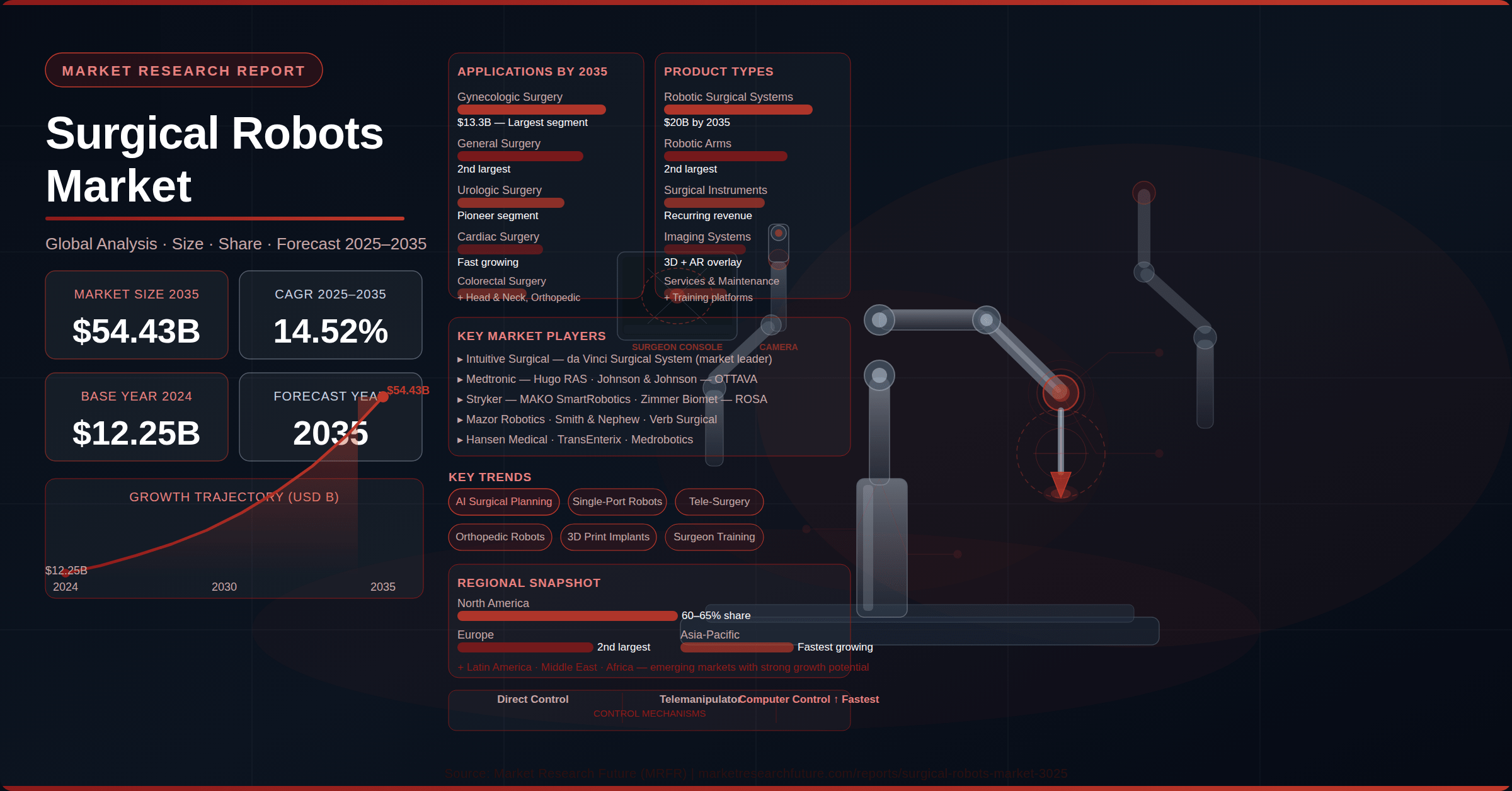
Pune, India — The global Surgical Robots Market is experiencing one of the most dynamic and technology-driven growth trajectories in the entire medical device landscape, according to the latest Surgical Robots Market report published by Market Research Future (MRFR). Valued at USD 12.25 billion in 2024, the market is projected to surge from USD 14.03 billion in 2025 to USD 54.43 billion by 2035, representing a compound annual growth rate (CAGR) of 14.52% during the forecast period 2025 to 2035. This extraordinary expansion — nearly quadrupling market value within a decade — reflects the irreversible global shift toward precision-guided, robotically assisted surgical care that improves clinical outcomes, reduces patient recovery times, and elevates surgical standards across virtually every medical specialty. The Surgical Robots Market growth mirrors the broader Longevity Market size expansion, as aging global populations increasingly require complex surgical interventions — from joint replacements and cardiac procedures to cancer surgeries — that demand the precision and safety advantages uniquely delivered by robotic surgical platforms.
Surgical Robots Market Summary
Surgical robots are advanced medical systems that integrate robotic arms, high-definition 3D imaging, AI-driven surgical planning software, motion-scaling technology, and haptic feedback mechanisms to enable surgeons to perform highly precise, minimally invasive procedures with enhanced dexterity, visualization, and control that exceeds the natural capabilities of the human hand. These systems span four primary product categories — Robotic Arms, Robotic Surgical System Devices, Surgical Instruments, and Imaging Systems — and operate through three control mechanisms: Direct Control, Telemanipulator Control, and Computer Control.
According to MRFR analysis, the Surgical Robots Market size reached USD 12.25 billion in 2024, anchored by Robotic Surgical Systems as the dominant product category, projected to reach USD 20.0 billion by 2035. The Surgical Robots Market share is distributed across gynecologic, general, cardiac, urologic, colorectal, and head and neck surgical applications — with Gynecologic Surgery emerging as the highest-value application segment, projected to reach USD 13.3 billion by 2035. The market is served across Hospitals and Ambulatory Surgical Centers, with hospitals holding the dominant end-user share. North America leads global market revenue, while Asia-Pacific is the fastest-growing region, driven by rapid healthcare infrastructure modernization and rising surgical robotics investment across China, India, Japan, and South Korea.
Request Your Sample Copy of This Strategic Report:
https://www.marketresearchfuture.com/sample_request/3025
Surgical Robots Market Growth Factors
The Surgical Robots Market growth is propelled by a powerful convergence of clinical, demographic, technological, and healthcare system forces:
- Surging Demand for Minimally Invasive Surgery: Patient and clinician preference for minimally invasive surgical approaches — offering reduced postoperative pain, shorter hospital stays, lower infection risk, faster recovery, and improved cosmetic outcomes — is the single most powerful structural driver of surgical robotics adoption. Robotic systems enable surgeons to perform complex laparoscopic, thoracoscopic, and endoscopic procedures with degrees of precision and dexterity unachievable through conventional manual approaches, making them the platform of choice for minimally invasive surgical programs globally.
- Rising Prevalence of Chronic Diseases and Surgical Volume: The growing global burden of conditions including cancer, cardiovascular disease, obesity, benign prostatic hyperplasia, and musculoskeletal disorders is driving significant increases in surgical procedure volumes that require the precision and reproducibility advantages of robotic platforms. Cancer surgeries — particularly prostatectomy, hysterectomy, colectomy, and thoracic resections — are among the highest-volume robotic surgical applications globally.
- Technological Advancements in AI and Robotics: The integration of artificial intelligence into surgical robot platforms is transforming surgical planning, intraoperative decision support, and postoperative outcome analysis. AI-driven surgical planning software, augmented reality overlays, autonomous instrument movement within defined safe zones, and machine learning-based complication prediction are collectively elevating the clinical value proposition of robotic surgery far beyond simple motion scaling and tremor filtering. The development of AI-driven surgical planning software and the expansion of robotic-assisted training programs for surgeons are among the most impactful current trends.
- Aging Global Population Driving Complex Surgical Demand: Aging demographics globally are generating substantial and sustained growth in surgical procedure volumes — particularly for orthopedic joint replacement, cardiovascular interventions, urologic procedures, and oncologic surgeries. Older patients particularly benefit from the reduced physiological stress and faster recovery profiles of robotic minimally invasive approaches, connecting the Surgical Robots Market growth directly to the Longevity Market growth demographic imperative.
- Integration of Telemedicine and Remote Surgery Capabilities: The integration of telemedicine capabilities in robotic systems is unlocking transformative possibilities for telestration, remote surgical mentoring, and — in emerging implementations — remote surgery itself. These capabilities are extending expert surgical expertise to underserved geographic markets and creating new demand vectors for surgical robotics platforms beyond traditional tertiary hospital settings.
🛒 Buy Now Premium Research Report –
https://www.marketresearchfuture.com/checkout?currency=one_user-USD&report_id=3025
Surgical Robots Market Trends
The Surgical Robots Market is being reshaped by a set of defining technological and commercial trends that will determine competitive dynamics through 2035:
- AI-Driven Surgical Planning and Intraoperative Guidance: The development and clinical deployment of AI-driven surgical planning software is among the most impactful trends reshaping the surgical robotics landscape. These platforms integrate preoperative imaging data, patient anatomy modeling, and procedural best-practice databases to generate optimized surgical plans — and then provide real-time intraoperative guidance that helps surgeons navigate critical anatomical structures with unprecedented safety. Intuitive Surgical’s da Vinci platform and Medtronic’s Hugo system are both integrating AI-powered analytics as core platform capabilities.
- Expansion of Single-Port and Flexible Robotic Systems: The evolution from multi-arm robotic systems requiring multiple incisions toward single-port robotic platforms — enabling complex procedures through a single small incision — represents a major clinical and commercial advancement. Single-port systems offer further reductions in patient trauma, scarring, and recovery time, expanding the clinical indications for robotic surgery and capturing new patient populations previously excluded from minimally invasive options.
- Robotic Surgery Training Ecosystem Expansion: The expansion of robotic-assisted training programs for surgeons — including simulation-based training platforms, proctorship programs, and AI-powered performance assessment tools — is accelerating the rate at which new surgical centers can adopt robotics and the speed at which surgeons can achieve procedural proficiency. This training ecosystem expansion is directly addressing one of the primary historical barriers to broader surgical robotics adoption.
- Orthopedic Robotics Emergence as High-Growth Specialty: Orthopedic surgical robots — for knee arthroplasty, hip replacement, and spinal surgery — are among the fastest-growing application segments, driven by the globally aging population’s rising burden of osteoarthritis and degenerative joint disease. Platforms including Stryker’s MAKO SmartRobotics and Zimmer Biomet’s ROSA system are capturing significant orthopedic hospital capital budgets globally.
- 3D Printing, Smart Implants, and IoT Integration: Advancements in 3D printing for custom surgical implants and the integration of smart implants with IoT connectivity are complementing robotic surgical platforms — enabling surgeons to combine robotic precision in implant placement with patient-specific implant geometries and real-time postoperative monitoring of implant performance.
Surgical Robots Market Segment Analysis
The Surgical Robots Market share is distributed across four primary dimensions — product type, application, control mechanism, and end user:
By Product Type, Robotic Surgical System Devices dominate the Surgical Robots Market as the single highest-value product category, projected to reach USD 20.0 billion by 2035. These comprehensive multi-arm surgical platforms represent the highest per-unit revenue opportunity and the most clinically versatile category, enabling a broad range of laparoscopic, thoracoscopic, and specialty procedures across multiple surgical disciplines. Robotic Arms — the mechanical manipulation subsystems of surgical robots — represent the second-largest product category. Surgical Instruments (endoscopic tools, staplers, energy devices, and specialty instruments designed for robotic platforms) and Imaging Systems (3D endoscopic cameras, augmented reality overlays, fluorescence imaging) complete the product ecosystem, both growing rapidly as hospitals scale robotic surgery programs and instrument replacement cycles generate recurring revenue.
By Application, Gynecologic Surgery is projected to reach USD 13.3 billion by 2035 — the single highest application segment valuation — driven by the high volume and clinical suitability of hysterectomy, myomectomy, sacrocolpopexy, and endometriosis resection procedures for robotic approaches. General Surgery is the second-largest application, encompassing cholecystectomy, colorectal resection, hernia repair, and bariatric procedures. Urologic Surgery — including prostatectomy and nephrectomy — has historically been the pioneering robotic surgery application and remains a major market contributor. Cardiac Surgery, Colorectal Surgery, and Head and Neck Surgery each represent important and growing application segments, with cardiac robotic surgery in particular gaining momentum as surgeons increasingly adopt minimally invasive approaches for mitral valve repair and coronary bypass grafting.
By Control Mechanism, Direct Control systems — where the surgeon’s hand movements are directly scaled and transmitted to robotic instruments — represent the largest and most established category, anchored by Intuitive Surgical’s da Vinci system. Computer Control systems — where software mediates between surgeon inputs and instrument movements, enabling features such as anatomical boundary enforcement and tremor filtering — are the fastest-growing control category, as AI integration deepens the autonomous capability envelope of surgical robots. Telemanipulator systems — enabling remote operation — represent a smaller but strategically important and rapidly growing segment as telemedicine and remote surgery capabilities advance.
By End User, Hospitals dominate the Surgical Robots Market end-user landscape, accounting for the vast majority of total installed robotic system capacity globally. Large academic medical centers and high-volume community hospitals are the primary purchasers of robotic surgical platforms, driven by competitive differentiation imperatives and the clinical breadth of their surgical programs. Ambulatory Surgical Centers are the fastest-growing end-user segment, as platform miniaturization, cost reduction, and the migration of lower-complexity procedures from hospital operating rooms to outpatient settings expand the addressable market for surgical robotics beyond traditional hospital boundaries.
Surgical Robots Market Regional Analysis
The Surgical Robots Market regional landscape reflects North America’s entrenched leadership, Europe’s sophisticated institutional adoption, and Asia-Pacific’s explosive growth momentum — a pattern that mirrors the Longevity Market share distribution globally, where the same demographic and healthcare investment forces are simultaneously expanding surgical volumes and robotic platform adoption:
North America leads the global Surgical Robots Market with approximately 60 to 65 percent of total market revenue, anchored overwhelmingly by the United States where Intuitive Surgical’s da Vinci platform has achieved deep penetration across academic medical centers, major community hospitals, and increasingly ambulatory surgical centers. The US benefits from advanced healthcare infrastructure, robust FDA regulatory pathways for surgical robotics innovation, strong private healthcare reimbursement frameworks for robotic procedures, and a highly innovation-receptive surgical community. Canada contributes meaningfully to regional demand as robotic surgery programs expand beyond major academic centers into regional hospitals.
Europe represents the second-largest Surgical Robots Market region, with Germany holding the largest national share driven by its advanced hospital infrastructure, high robotic surgery adoption rates, and strong domestic medical technology manufacturing ecosystem. The United Kingdom — through NHS England’s targeted investment in robotic surgery programs — France, Italy, and Spain all contribute significant market demand. The EU IVDR and CE marking regulatory frameworks are also beginning to shape surgical robotics market access dynamics across the region.
Asia-Pacific is the fastest-growing regional market in the Surgical Robots sector, driven by massive and aging population bases, surging healthcare infrastructure investment, rapidly rising per capita healthcare expenditure, and significant government initiatives promoting advanced medical technology adoption. China holds the largest national share within Asia-Pacific, with both domestic robotic surgery platform development — including Toumai laparoscopic robots — and accelerating imports of international systems driving market expansion. Japan, South Korea, India, and Australia are all important and growing contributors to regional demand. The demographic parallel with the broader Longevity Market growth dynamics in Asia-Pacific is especially pronounced in surgical robotics — aging populations requiring musculoskeletal, oncologic, and cardiac surgical interventions are simultaneously expanding demand for precision robotic platforms.
Latin America and the Middle East and Africa represent emerging Surgical Robots Markets, with Brazil, Mexico, Saudi Arabia, and the UAE serving as primary demand anchors as healthcare modernization programs and private hospital investment expand access to robotic surgery beyond major metropolitan centers.
Key Market Players
The global Surgical Robots Market is anchored by a competitive ecosystem of surgical robotics pioneers, diversified medical device conglomerates, and a rapidly expanding cohort of innovative challengers. Key players identified in this Surgical Robots Market report include Intuitive Surgical Inc. (US) — the dominant market leader with its da Vinci Surgical System — Medtronic plc (Ireland) with its Hugo RAS system, Johnson and Johnson MedTech (US) with its OTTAVA platform, Stryker Corporation (US) with MAKO SmartRobotics for orthopedics, Zimmer Biomet (US) with ROSA Robotics, Mazor Robotics (Israel), Smith and Nephew (UK), Renishaw plc (UK), TransEnterix Inc. (US), Medrobotics Corporation (US), Verb Surgical Inc. (US), Medtech SA (France), and Hansen Medical (US). These organizations are collectively investing in AI integration, single-port systems, training platform expansion, emerging market penetration, and next-generation robotic capabilities to capture the market’s extraordinary 14.52% CAGR growth opportunity through 2035.
Explore Our Latest Reports
About Market Research Future (MRFR)
Market Research Future (MRFR) is a leading global market research organization providing comprehensive, data-driven analysis across a wide spectrum of industries. For full report details, visit: www.marketresearchfuture.com/reports/surgical-robots-market-3025
Contact: info@marketresearchfuture.com | +1 (855) 661-4441